Quick Answer
Someone who is emotionally unavailable has difficulty forming or sustaining a close emotional connection. They tend to deflect serious conversations, keep things surface-level, avoid commitment and run hot and cold. It’s usually a protective pattern learned early rather than a decision to withhold, which explains why pushing harder rarely works and why the person often can’t explain it either.
You can be close to someone for a year and still feel like you’re standing outside a locked door. They’re present, they may be affectionate and yet every conversation that goes below a certain depth gets deflected with a joke, a subject change or a silence you eventually stop trying to fill.
That experience is disorienting in a particular way because there’s often nothing you can point to. Nobody is being cruel. Nothing has technically gone wrong. You just can’t get any closer, and after a while you start wondering whether the problem is that you need too much.
This article covers what emotional unavailability actually is, how to recognize it, where it comes from, what you can realistically change and what you can’t and how to tell it apart from the things it gets confused with. If the situation has started wearing on your own mental health, you can call the Mental Health Hotline at 866-903-3787 to talk through options.
What Does Emotional Unavailability Mean?
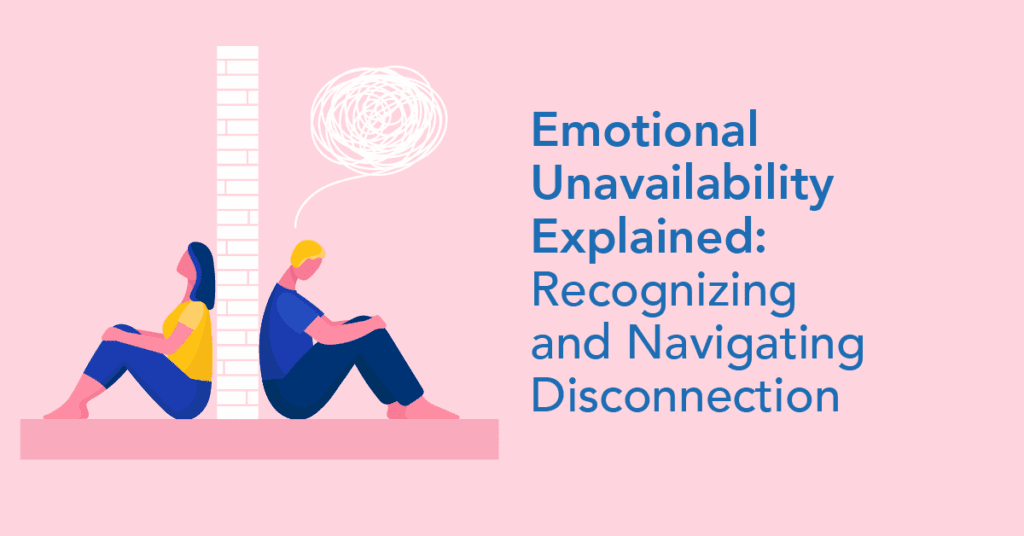
Emotional unavailability describes a persistent difficulty connecting with other people at an emotional level. The person avoids vulnerability, shuts down during serious conversations or keeps the people who care about them at a fixed distance that never seems to close.
It can be deliberate, but more often it isn’t. Some people developed the pattern after being hurt badly enough that closeness now registers as risk. Others never learned how to name or express feelings because nobody around them did it. Either way, the behavior tends to run automatically, which is why the person is frequently as confused by it as you are.
One thing worth establishing early: emotional unavailability isn’t the same as not caring. It usually means the opposite is happening internally and can’t get out. That distinction matters for how you respond, though it doesn’t obligate you to keep waiting.
A Note on the Phrase “Emotionally Inept”
People searching for this often land on the phrase emotionally inept. It captures something real, and it’s also slightly the wrong frame. Inept implies a skills deficit, as though the person simply never learned and could pick it up with instruction.
Sometimes that’s accurate. More often the skill isn’t missing. It’s inhibited. The person can identify what they feel and has learned, usually early and thoroughly, that expressing it is unsafe. That’s a protective response rather than a competence gap, and it responds to safety rather than to teaching. Worth knowing before you try to coach someone through it.
Signs Someone Is Emotionally Unavailable
The pattern shows up in small, deniable ways, which is what makes it so hard to name. You may notice you’re always the one reaching, while the other person adjusts their distance to keep the gap constant.
In Conversation
- Deflects emotionally charged topics with humor or a subject change
- Gives vague answers when asked how they feel or answers a different question
- Goes silent during conflict rather than working through it
- Becomes defensive when you raise anything about the relationship itself
- Shares little personal history, even after a long time together
In the Relationship
- Dodges commitment, labels or conversations about the future
- Runs hot and cold. Warm and open one week, withdrawn the next, with no explanation
- Keeps things physical while remaining distant emotionally
- Prioritizes work or hobbies over the relationship in a way that feels structural rather than situational
- Struggles to empathize or responds to your distress with problem-solving or irritation
- Keeps friendships and family relationships equally surface-level, not just this one
That last point can tell you something useful. If the distance is specific to you, that’s information about the relationship. If it’s uniform across every relationship they have, it’s information about them.
The inconsistency is usually the most destabilizing part. Running hot and cold produces a specific kind of self-doubt, where you replay the week trying to find what you did to cause the shift. Usually you didn’t do anything. Closeness itself is the trigger, and warmth is often what precedes the withdrawal rather than what contradicts it.
What It Is Not
Several different situations produce similar behavior, and confusing them can lead people to wait for something that isn’t going to change or to leave something that would have.
| What You May Notice | How to Tell | |
|---|---|---|
| Emotional unavailability | Consistent distance across relationships, deflection, hot and cold. | The pattern predates you and shows up everywhere, including with friends and family. |
| Low expressiveness | Quiet, undemonstrative, not verbally affectionate. | They show up reliably, engage when you ask directly and the closeness is real even if it’s quiet. |
| Depression | Withdrawal, flat affect, loss of interest in the relationship. | It started at an identifiable point and comes with sleep, appetite or energy changes. |
| Acute stress or grief | Temporary shutdown, less capacity for anyone else. | It maps onto an event, and the person can usually say so if asked. |
| They are not invested | Distance specific to you, effort that never appears. | They’re warm and open with others and reserve the distance for this relationship. |
| Stonewalling as control | Silence used as punishment after you raise something. | The withdrawal is targeted, follows your complaints and ends when you concede. |
That last row deserves particular attention. Emotional unavailability is a difficulty. Withholding communication deliberately to punish someone or force compliance is a different thing, and it appears on our page about emotional abuse. The distinguishing question is whether the silence is protective or strategic, which usually becomes clear from whether it lifts on its own or only after you give in.
Where Emotional Unavailability Comes From
This doesn’t appear from nowhere. It’s generally built over years out of experiences that made emotional openness feel costly.
Early Environment
People who grew up where feelings were unwelcome, mocked or ignored learn to manage emotion by suppressing it. Attachment research describes this as a set of deactivating strategies: the emotional system gets turned down rather than expressed because expressing it never produced a useful response. This is the core of what’s usually called an avoidant attachment pattern, and our guide to attachment styles covers how the different patterns show up in adult relationships.
Trauma and Earlier Relationships
Being hurt or abandoned makes opening up feel genuinely dangerous rather than merely uncomfortable. Childhood trauma has a documented effect on the attachment system and on the capacity for intimacy in adulthood. Research on U.S. adults suggests that about 35% experienced emotional abuse as a child, with substantial variation by state. A meaningful share of the adults now described as distant are carrying something that started long before their current relationship.
Mental Health Conditions
Depression, anxiety and other conditions can make emotional closeness harder to sustain. Someone managing untreated symptoms may have very little capacity left over for anyone else and may experience your bids for connection as demands they can’t meet.
None of this is an argument for waiting indefinitely. Understanding the origin helps you respond with less self-blame and more accuracy. It doesn’t obligate you to absorb the cost forever while someone else decides whether to work on it.
What You Can Change and What You Cannot
This is the part most articles get wrong, usually by implying that enough patience will eventually unlock someone. It won’t, on its own. What patience does is remove one obstacle. The person still has to decide to do the work.
Things That Genuinely Help
- Ask specific questions rather than open ones. “How are you feeling about the move?” is answerable. “Why don’t you ever open up?” is an accusation with a question mark on it.
- Respond calmly when they do share. The first attempts are fragile. A big reaction, positive or negative, can teach them that disclosure is expensive.
- Be consistent. Predictability does more than intensity here. People are more likely to open up in environments that stay consistent, not in ones that reward them dramatically.
- Name the pattern once, plainly, outside of a fight. Describe what you observe and what you need. Then stop repeating it because repetition can turn into pressure, and pressure can produce more distance.
- Work on your own side of it. Building your own emotional intelligence and getting clearer about what you actually need can make the conversation more precise and easier to act on.
Things That Don't Work
- Waiting quietly. Hoping they notice usually leaves the pattern unchanged.
- Escalating. More intensity can feel like more threat and produce more withdrawal.
- Becoming their therapist. Trying to treat a partner can blur both roles.
- Accepting less and calling it acceptance. There’s a real difference between adjusting your expectations and abandoning your needs.
The Question Worth Asking Yourself
If this is a recurring type rather than a one-time situation, that’s worth looking at directly. Some people are consistently drawn to partners who can’t fully show up, often because earning closeness feels more familiar than receiving it. That’s not a character flaw and it’s not your fault, but it is a pattern you have some control over, unlike your partner’s. Our page on the signs of codependency covers the version of this where caretaking has become the basis of the relationship. If you want help thinking it through or finding support, calling 866-903-3787 is a reasonable place to start.
If You Are the Emotionally Unavailable One
Recognizing yourself here is uncomfortable and useful. It usually doesn’t mean you’re cold. It more often means that at some point emotional openness stopped being safe, and the adaptation you built has outlived the situation that required it.
Give yourself some room on this. The pattern likely took time to build and won’t dissolve in a conversation. Practical starting points: practice naming what you feel privately before attempting it out loud, notice the physical sensation that arrives right before you shut down and try tolerating one uncomfortable conversation without ending it early.
Therapy can be a useful option because the pattern may be largely automatic and difficult to see from the inside. Couples therapy may help when both people are willing, while individual therapy may be a better starting point when the roots are older than the relationship. If you’re not sure which fits or where to look for support, calling 866-903-3787 is a reasonable place to start.
Frequently Asked Questions
Yes, though only if they want to and are willing to do the work. The pattern can change, often with therapy. What doesn’t work is one person deciding to change on behalf of the other. If your partner acknowledges the pattern and takes steps, that’s meaningful. If they agree it’s a problem and nothing changes over time, that’s also information.
There’s no single correct interval, but watch direction rather than speed. Progress in this area can be slow and uneven. What doesn’t count is repeated agreement with no accompanying behavior. If you’ve raised it clearly more than once and nothing has shifted, you’re no longer waiting for change. You’re deciding what you can live with.
They overlap heavily but aren’t identical. Avoidant attachment is a specific research framework describing how someone regulates closeness. Emotional unavailability is a broader everyday description that can also stem from depression, current stress or simply not being invested in this particular relationship.
Closeness can be the trigger. For someone whose early experience taught them that depending on people ends badly, a genuinely good moment may raise the stakes and activate a protective response. The withdrawal can follow connection rather than conflict, which is exactly why it feels so illogical from the outside.
Wanting to be known by the person closest to you isn’t excessive. It’s worth being specific about what you’re asking for, since “be more open” is difficult to act on, but the underlying need is ordinary and reasonable.
Where to Start
Whether you’re the one reaching or the one who can’t quite reach back, this pattern can change with attention and effort. Progress may be slow, and outside support can help. What it doesn’t do is resolve by itself while everyone waits politely.
The Mental Health Hotline is available 24/7 to answer questions and help you explore support options. Calls are free and confidential.
Sources
- Mikulincer M, Shaver PR. Attachment in Adulthood: Structure, Dynamics, and Change. Guilford Press. Deactivating strategies and avoidant attachment.
- National Library of Medicine, PubMed Central. Childhood emotional abuse prevalence among U.S. adults by state.
- National Library of Medicine, PubMed Central. Emotionally abusive parenting and adult attachment outcomes.
- Bowlby J. Attachment and Loss. Foundational attachment theory.
- American Psychological Association. Adult attachment and intimate relationships.
Reviewed by Daphne Fatter, Ph.D.
Editorial Team
-
Written By: Mental Health HotlineMental Health Hotline provides free, confidential support for individuals navigating mental health challenges and treatment options. Our content is created by a team of advocates and writers dedicated to offering clear, compassionate, and stigma-free information to help you take the next step toward healing.