
How to Help Someone With Anxiety
⚠ SAFETY NOTICE
If you or someone you love is in immediate danger, call 911.
If you’re having thoughts of suicide or are in emotional crisis, call or text 988 to reach the Suicide & Crisis Lifeline.
The Mental Health Hotline offers support and resources and is not a substitute for emergency services.
Watching someone you love struggle with anxiety is hard. You want to fix it, but anxiety doesn’t usually respond to quick fixes. What helps more is presence, patience and the right kind of support over time. The good news is that you don’t need to be a therapist to make a real difference.
According to the National Alliance on Mental Illness, anxiety disorders affect nearly 1 in 5 U.S. adults in any given year. Whether it’s generalized anxiety, panic attacks, social anxiety or specific phobias, your willingness to show up matters more than getting every word right. If you’re not sure what to do next or just need to talk to someone yourself, the Mental Health Hotline at 866-903-3787 is open 24/7.
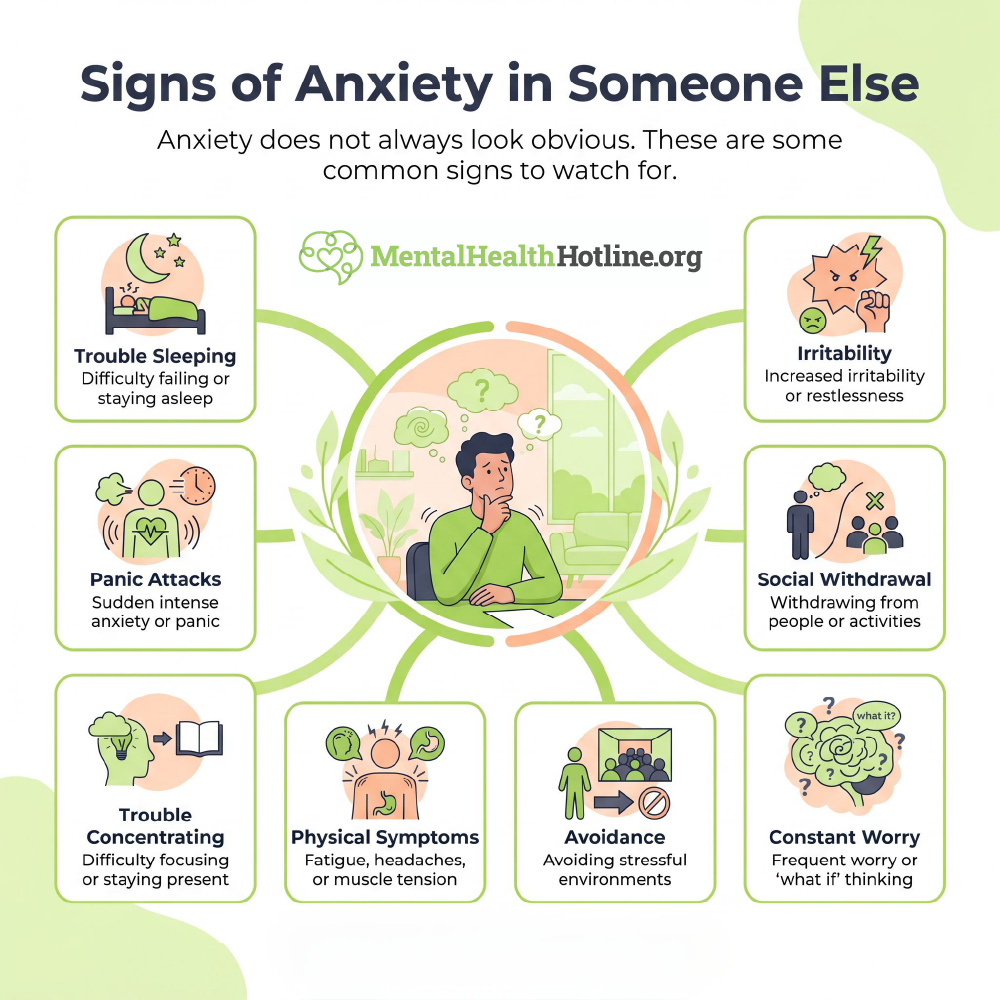
Recognizing the Signs of Anxiety in Someone Else
- Trouble sleeping or staying asleep
- Increased irritability or restlessness
- Withdrawal from social interactions or activities they used to enjoy
- Frequent worry, rumination or “what if” thinking
- Avoidance of certain places, people or situations
- Physical complaints, including headaches, stomachaches, muscle tension and fatigue
- Trouble concentrating
- Panic attacks
What to Say to Someone With Anxiety
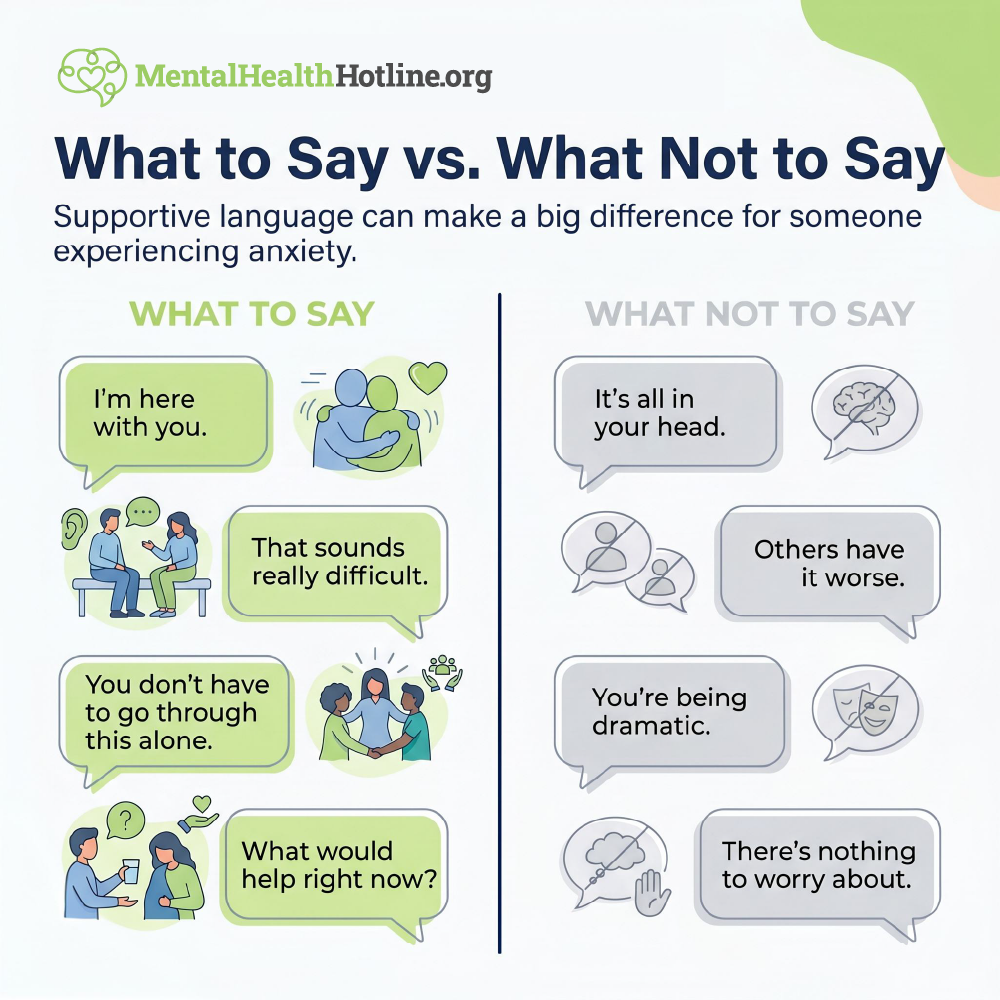
You don’t need perfect words. The most helpful thing you can do is listen with empathy. A few phrases that tend to land well:
- “I’m here with you.”
- “That sounds really tough. Want to talk about it?”
- “You don’t have to go through this alone.”
- “I may not understand exactly what this feels like, but I want to.”
- “What would actually help right now?”
What Not to Say to Someone With Anxiety
Even with good intentions, certain phrases tend to make things worse:
- “It’s all in your head.”
- “Others have it worse.”
- “You’re being dramatic.”
- “Have you tried meditating?” (Especially when said dismissively.)
- “There’s nothing to be anxious about.”
How to Support Someone With Anxiety
Effective support looks different in the moment than it does over the long haul. Here’s how to think about both:
In the Moment
When someone is in the middle of an anxiety spike or panic attack, your job is to help them feel safe, not to talk them out of the anxiety. Stay calm yourself; slow your own breathing first. Try grounding together: 5-4-3-2-1 (name five things you see, four you feel, three you hear, two you smell, one you taste) or box breathing (inhale 4 seconds, hold 4, exhale 4, hold 4). Use simple, reassuring language: “You’re safe. I’m here. This will pass.” Don’t try to reason them out of it. During acute anxiety, it can be hard to think clearly. For more options, see our guide to grounding techniques and how to help during an anxiety attack.
In the Medium Term
Between acute moments, help create the conditions where their nervous system can settle. Respect their boundaries, but don’t fully accommodate avoidance. This is the tricky balance: long-term avoidance reinforces anxiety, so support gentle, gradual exposure rather than pressure to push through. Help maintain healthy lifestyle habits: sleep, food, gentle movement and time outside. None of these cure anxiety, but all support recovery.
Long-Term
Sustainable support helps them build skills and treatment habits they can use over time. Encourage professional help (more on this below). Support healthy lifestyle habits. Regular movement, balanced sleep and reduced caffeine and alcohol can all affect anxiety. Encourage long-term skills like cognitive behavioral therapy, mindfulness practices and journaling. Celebrate small wins. Showing up to something they would have skipped a year ago is real progress.
Supporting a Partner or Spouse With Anxiety
Anxiety in a relationship is its own kind of difficult, for them and for you. A few patterns worth knowing:
- Watch for accommodation creep. Partners often gradually take over the things that trigger their loved one’s anxiety: making the calls, handling social plans and taking care of anything that feels stressful. Some accommodation is loving, but too much can make anxiety worse over time and wear you down.
- Protect connection. Anxiety can leave both of you with less energy for each other. Make space for moments that aren’t about managing symptoms.
- Talk about who handles what at home. If anxiety is affecting your partner’s ability to handle parts of household life, talk about it before either of you starts to feel resentful.
- Watch for substance-use coping. Partners often see drinking, cannabis or medication patterns shift before anyone else does. If something seems off, bring it up calmly before the pattern gets worse.

If you want a deeper read on the dynamics, our guide to living with someone with anxiety goes further.
Supporting Teens or Children With Anxiety
Anxiety in kids and teens often shows up as irritability, school avoidance, physical complaints (“my stomach hurts”) or sudden withdrawal. Create safe, predictable routines. Validate the feeling before trying to solve the problem. Ask open-ended questions like “What’s been on your mind lately?” Avoid pushing them into feared situations all at once. If anxiety is affecting school, sleep or daily functioning, a pediatric therapist can help. A pediatrician is usually a good first stop for referrals.
How to Help Someone Find Treatment
Anxiety is highly treatable, but according to the World Health Organization, only about 1 in 4 people with anxiety disorders ever receive treatment. Helping with the next step can make treatment feel less overwhelming.
- Offer to do the research. Looking up therapists, checking insurance and reading provider bios can feel overwhelming when you’re already anxious. You can do that part.
- Help with the first call and logistics. Sit with them while they call or offer to make the initial call yourself if they consent. Drive them to the first session. Walk through forms, insurance questions or other barriers one at a time.
- Discuss medication openly if it comes up. Anti-anxiety medications, SSRIs and beta-blockers may be options. See our guide to medication for anxiety for a balanced overview. Avoid dismissing or pushing it; it’s their decision with their prescriber.
- What to look for in a therapist. Cognitive behavioral therapy and exposure therapy are commonly used to treat anxiety. On the first call, ask about the therapist’s specialties and how they treat anxiety.
Our guide to finding a therapist walks through the process in more detail.
When to Seek Crisis Help
Anxiety is treatable, but sometimes things escalate beyond what loved ones and outpatient care can handle. Don’t wait if your loved one:
- Has frequent panic attacks that don’t improve with coping tools or support
- Is unable to perform basic daily tasks for more than a short time
- Has anxiety that’s clearly getting worse over time
- Is using substances to cope
- Has intrusive thoughts of suicide or self-harm
In a crisis, call 988 (call or text) for the Suicide and Crisis Lifeline, or 911 if there’s immediate danger. The Crisis Text Line (text HOME to 741741) is another option.
Frequently Asked Questions
Stress usually has a clear external trigger and resolves when the situation does. Anxiety persists even when life calms down and tends to interfere with sleep, work or relationships. If symptoms stick around for weeks or months, a professional evaluation is worth it.
Stay calm. Reassure them: “I’m here. Let’s breathe together.” Don’t try to reason them out of the feeling. During panic, it can be hard to think clearly. Sit with them, offer grounding and let it pass. It always does.
Mild, situational anxiety often improves with time. Clinical anxiety disorders usually benefit from therapy, structured support and sometimes medication. Untreated anxiety can get harder to manage over time. Earlier support often leads to better outcomes.
Lead with curiosity, not pressure. “Have you thought about talking to someone?” lands better than “You need a therapist.” Offer to help with logistics. Normalize therapy. Be patient. The conversation may need to happen more than once.
This is harder than it sounds, and more common than people think. You can’t force an adult into treatment unless there’s an imminent safety concern. What you can do: keep showing up without making every interaction about treatment, share information without lecturing, model your own care and watch for moments when they might be more open. If safety becomes a real concern, call 988 for guidance.
You're Not Alone in Supporting Someone With Anxiety
Your patience and steadiness matter more than you may realize. If you’re feeling overwhelmed or unsure what to do, the Mental Health Hotline is here 24/7 at 866-903-3787 for both the person facing anxiety and the loved ones supporting them.